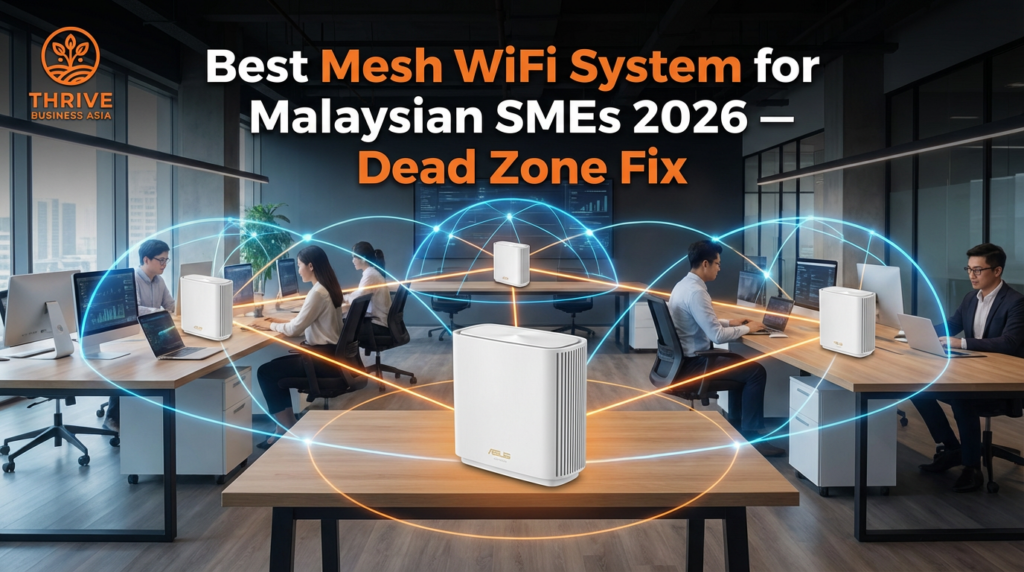
Best Mesh WiFi System for Malaysian SMEs 2026 — Dead Zone Fix
📅 · 💬 comments · ⏱ 5 min read
📡 Malaysia · Networking & Connectivity · Highest Networking AOV
Best Mesh WiFi System for Malaysian SMEs 2026 — Dead Zone Fix
Your Unifi 500Mbps plan feels like 50Mbps in half your office. That’s not your ISP’s fault — it’s your router architecture. A single router cannot cover a double-storey shophouse or a 4,000 sq ft office without dead zones. Mesh WiFi solves this permanently.
6
Systems Compared
~RM100
Max Commission/Sale
RM1,200
Avg Order Value
5/5
ROI Signal
Shopee Affiliate links verified February 2026. TP-Link Deco and ASUS ZenWiFi dominate the MY market — tri-band recommended for offices. Verify stock on publish day.
✓ TP-Link Deco vs ASUS ZenWiFi compared
✓ Tri-band vs dual-band decision covered
✓ Shopee Mall sellers — Unifi/Maxis compatible
✓ RM600–2,000 full range covered
✓ Malaysian space types: shophouse, condo, office
✓ Networking & Connectivity guide
🛒 Available on Shopee Malaysia · Highest Networking AOV: ~RM40–100/sale | View on Shopee →
📋 Quick Summary
If your team moves between rooms and WiFi drops, you don’t need faster internet — you need mesh. A single router, regardless of how expensive or how fast your ISP plan is, physically cannot maintain consistent signal strength across multiple floors, rooms separated by concrete walls, or spaces larger than approximately 1,500 sq ft. This is physics — signal attenuates with distance and obstructions.
Mesh WiFi systems replace the single-router architecture with multiple nodes that communicate with each other on a dedicated backhaul channel, providing seamless roaming — your device stays connected as you move between nodes without dropping connection or requiring manual reconnection. For Malaysian SMEs in shophouses, multi-floor offices, or larger condominiums: mesh is the permanent infrastructure solution.
Quick Verdict:TP-Link Deco is the #1 recommendation for Malaysian SMEs — strongest Shopee MY Mall presence, Unifi/Maxis compatible, widest range from AX1800 budget to AX5400 premium. ASUS ZenWiFi is the premium alternative for buyers who need the most advanced parental controls and enterprise-grade app features. For most Malaysian offices: Deco AX3000 3-pack (Best Overall, RM900–1,400) covers the use case comprehensively.
Why a “Faster Router” Doesn’t Fix Your Dead Zones
Razif runs a 12-person digital marketing agency in a 3-storey Petaling Jaya shophouse. Ground floor: client meetings and reception. First floor: account managers and designers. Second floor: creative and development. He upgraded from a TP-Link AC1200 to an ASUS AX3000 in 2024. The second floor still barely gets signal. He paid RM450 for a router that didn’t solve the problem. Here’s why.
⚠️ Why Even a Premium Single Router Fails in Multi-Floor Spaces
WiFi signal is attenuated by every physical obstacle it passes through. Concrete floors — the standard construction material in Malaysian shophouses and most commercial buildings — are among the most signal-attenuating materials in common use. A concrete floor between floors 1 and 2 reduces 5GHz WiFi signal by 15–20dB — reducing usable throughput from 500Mbps to under 50Mbps at the same distance through concrete as through open air.
No router upgrade fixes this. The problem is not router quality — it’s physics. The only architectural solution is a signal source on each floor, coordinated by a mesh backhaul. A RM2,000 single router underperforms a RM800 mesh system in Razif’s shophouse.
⚠️ Why WiFi Repeaters Are Not the Answer
Many Malaysian SME owners try to fix dead zones with WiFi repeaters (range extenders) — a RM80–150 device that picks up the router signal and rebroadcasts it. The problem: a repeater creates a separate network with a different SSID, your device doesn’t automatically roam between them, and the repeater operates on the same channel as the router — halving throughput in the process. A WiFi repeater doesn’t solve the dead zone problem — it creates a second, weaker, disconnected island of connectivity.
📡 How Mesh WiFi Solves This Architecturally
Mesh nodes communicate with each other on a dedicated backhaul band (tri-band systems use the third band exclusively for node-to-node communication, preserving full 2.4GHz and 5GHz client bandwidth). Your devices see a single network — same SSID, same password. As you move through the space, your device seamlessly hands off from one node to the next without disconnection. The result: full-speed connectivity in every room, on every floor, managed from one app.
Three Network Architectures — Which One Is Your Office Running?
❌ Most Malaysian SMEs Today
Single Router
RM250–600 · Covers ~1,500 sq ft
One signal source for entire space
Signal degrades with distance + walls
Concrete floors kill 5GHz signal
Dead zones are architectural — unfixable
Works for: single-floor under 1,500 sq ft
⚠️ Common Mistake — Avoid
Router + Repeater
RM350–750 · Partial fix only
Separate SSID — manual reconnect required
Half bandwidth (shares channel with router)
No seamless roaming — device drops on move
Creates 2 isolated networks, not 1 unified
Appears to fix the problem — doesn’t
✅ Correct Solution — Malaysian SME
Mesh System (3-Pack)
RM600–2,000 · Covers 4,000–6,000+ sq ft
Single SSID — seamless roaming
Dedicated backhaul (tri-band) = full speed
Each floor gets a node — concrete bypass
One app, unified management
Scales: add nodes as space grows
Before and After — Razif’s 3-Storey Shophouse
📡
Single Router — AX3000 (RM450)
Ground floor: 400Mbps ✓ · First floor: 180Mbps (concrete attenuation) · Second floor: 35Mbps (barely usable) · Meeting room corner: dead zone · Staff on 2nd floor: constant Slack disconnections, Teams calls unstable
🌐
Mesh 3-Pack — Deco AX3000 (RM1,100)
Ground floor node: 450Mbps ✓ · First floor node: 420Mbps ✓ · Second floor node: 430Mbps ✓ · Meeting room: full signal ✓ · All staff: stable connections, seamless roaming between floors · Single SSID, one app
The 10-Staff Productivity Cost of Dead Zones
Staff on affected floor/area (second floor, 5 staff)5 people
Daily time lost to connection issues (Teams drops, Slack disconnects)30 min/person
Daily cost (5 × 30 min × RM25/hr avg wage)RM62.50/day
Monthly productivity cost (22 working days)RM1,375/month
Best Overall Deco AX3000 3-pack (one-time)RM1,100
Payback periodUnder 18 days
💸 Dead Zone Architecture — Monthly Cost
Staff productivity loss: RM1,375/month
Client call reliability issues: RM500+/month
IT troubleshooting time: RM200/month
Annual cost: RM24,900+
✅ Mesh System — One-Time Fix
Deco AX3000 3-pack: RM1,100
Setup time: 30–45 minutes
All floors: full-speed coverage
ROI: 22× in year one
👤 Buyer Profiles
Do You Need Mesh or a Single Router?
The decision is based on space type and existing dead zones — not on internet speed or device count.
✅ You Need Mesh If…
Your office or home spans 2+ floors
You have a shophouse, medium office, or large condo
Staff move between rooms and connections drop
You have specific dead zones (back office, store room, meeting room)
Your space is over 1,500 sq ft on a single floor
You have a router + repeater setup that doesn’t work properly
❌ Stick with Single Router If…
Single floor under 1,500 sq ft with no dead zones
Small home office in a standard condo unit (single floor)
You just need faster speeds in one area — not dead zone coverage
Budget is under RM600 — a good AX3000 single router is better value
Your ISP provided a strong combo modem-router that covers your space
Mesh Recommendation by Malaysian Space Type
🏠
Standard Condo / Apartment
Under 1,200 sq ft · Single floor
Single router usually sufficient. 2-node mesh only if layout is unusual or there’s a dedicated study room with concrete walls.
🏢
Shophouse / Multi-Floor Office
1,500–4,000+ sq ft · 2–3 floors
Mesh 3-pack is the correct solution. One node per floor. TP-Link Deco AX3000 covers this use case definitively.
🏗️
Large Bungalow / SME Office 20+ pax
3,000–6,000+ sq ft
3-pack minimum, possibly 4–6 nodes. Tri-band essential. Consider wired backhaul (Ethernet between nodes) for maximum performance.
Space Type
Size
Recommendation
Tier
Price
Single-floor condo
Under 1,200 sq ft
Single router
WiFi 6 Router guide
RM250–600
Shophouse / 2-floor office ⭐
1,500–4,000 sq ft
Mesh 3-pack
Best Overall
RM900–1,400
Condo with dead zones
1,200–2,000 sq ft
Mesh 2-pack or 3-pack
Best Value
RM600–900
Large office 20+ pax
3,000+ sq ft
Mesh 4–6 nodes
Premium / Enterprise
RM1,400–2,000+
🔍 Buying Criteria
Tri-Band vs Dual-Band — and Four Other Specs That Matter
📡 Tri-Band vs Dual-Band — The Backhaul Question
Dual-band mesh systems share the 5GHz band between client devices and node-to-node backhaul communication. Tri-band systems dedicate the third band exclusively to backhaul — meaning client devices get their full 5GHz bandwidth regardless of node communication overhead. For a 10+ device office: tri-band is required. For a home with 5–10 devices: dual-band is acceptable at a lower price point.
📱 App Management — One App for Everything
TP-Link Deco uses the Tether app; ASUS ZenWiFi uses ASUS Router app. Both offer unified management: see all connected devices, manage parental controls, QoS (Quality of Service — prioritise video calls over file downloads), and add nodes through the same interface. For SME owners: the ability to prioritise bandwidth for video conference devices during business hours is a meaningful feature.
🔌 Wired Backhaul Option
If your shophouse or office already has Ethernet cabling between floors (or you’re willing to install it), wired backhaul connects mesh nodes via cable rather than wireless — delivering maximum throughput and zero wireless interference between nodes. Both TP-Link Deco and ASUS ZenWiFi support wired backhaul. For offices where cable installation is possible: wired backhaul is always the better architecture.
📶 Coverage Area Claims — Apply 60% Rule
Mesh system coverage claims are calculated in open-air, no-obstruction conditions. For Malaysian shophouses and commercial spaces with concrete walls and floors: apply a 60% rule to coverage claims. A system claiming 5,000 sq ft total coverage delivers approximately 3,000 sq ft in a typical Malaysian shophouse. Plan node placement accordingly — one per floor, centred in the floor’s primary usage area.
Unifi & Maxis Fibre Compatibility: Both TP-Link Deco and ASUS ZenWiFi support PPPoE configuration — required for Unifi (TM) and Maxis Fibre connections in Malaysia. Connect your mesh system’s primary node to your ISP’s ONT (the fibre termination box) via Ethernet, configure PPPoE credentials in the app, and the system handles everything else. The secondary/satellite nodes connect wirelessly or via Ethernet backhaul. No ISP contract changes required.
🏆 Top Picks — Shopee Malaysia 2026
Choose Your Mesh WiFi System
TP-Link Deco and ASUS ZenWiFi — the two dominant mesh brands on Shopee MY with verified Unifi/Maxis compatibility and Shopee Mall presence.
🥇 Best Overall · SME Office / ShophouseTOP PICK
TP-Link Deco AX3000 · Shopee Mall · 4.5★+
Mesh WiFi 6 System — 3-Pack, Tri-Band, AX3000, Seamless Roaming
RM 1,500+900– RM 1,400~RM 45–70/sale
WiFi StandardWiFi 6 (802.11ax)
Speed RatingAX3000 per node
BandsTri-band (dedicated backhaul)
Coverage~500m² / ~5,400 sq ft (open air)
Devices150+ devices stable
Est. Commission~RM 45–70/sale
✓ Unifi & Maxis Fibre (PPPoE) compatible
✓ TP-Link Tether app — single unified management
✓ Wired backhaul supported (Ethernet between nodes)
Eliminate Dead Zones — Seamless Coverage Across Your Entire Space
Affiliate links verified February 2026. TP-Link Deco and ASUS ZenWiFi — Shopee Mall sellers, Unifi/Maxis compatible, Malaysia warranty. Verify tri-band vs dual-band before publishing.
Node Placement Is Critical: The most common mesh WiFi underperformance issue is poor node placement. Each node should be within 10–12 metres of the next (line-of-sight or through a single wall), placed in a central position on each floor, elevated off the floor (shelf or high table position), and away from microwaves, cordless phones, and other 2.4GHz interference sources. For shophouse deployments: one node per floor, centred in the floor’s main working area — not in a server room or enclosed space.
🛡️ Why These Brands
TP-Link Deco vs ASUS ZenWiFi — Malaysian Context
🏆
TP-Link Deco — #1 for Malaysian SMEs
TP-Link has the strongest Shopee MY Mall presence in the mesh category, the widest range from AX1800 to AX5400, and the most active Malaysian community support. The Tether app is widely regarded as the most user-friendly mesh management interface available in Malaysia. First choice for any SME buyer who wants reliable setup and strong post-purchase support.
⚡
ASUS ZenWiFi — Premium Alternative
ASUS ZenWiFi offers stronger parental controls, more granular QoS options, and enterprise-adjacent features (VLAN support, advanced security settings) that appeal to technically sophisticated buyers. Higher price point — RM1,200–2,000 for the 3-pack. The ASUS Router app is capable but has a steeper learning curve than TP-Link Tether. Recommended for technically inclined buyers who need advanced features.
🔒
Firmware Security — Both Active
Both TP-Link and ASUS maintain active firmware security update cycles for their Malaysian Mall-listed mesh products. For a business network that handles sensitive data: firmware update frequency is a security consideration. Verify the specific model you’re purchasing has had a firmware update within the past 6 months — both brands typically meet this threshold for their current-generation products.
❓ Frequently Asked Questions
Mesh WiFi Malaysia — FAQ
Do I need mesh WiFi if I have a WiFi 6 router and my space is 2,000 sq ft on a single floor?
Possibly not — it depends on your layout. A modern WiFi 6 AX3000 router covers approximately 1,500 sq ft in open-air conditions. For a 2,000 sq ft open-plan space with a centrally placed router: the router likely covers most of the space adequately. Where you need mesh on a single floor: long rectangular layouts where the router can’t be centrally placed (e.g., a shopfront that extends 40+ metres), spaces with multiple concrete partition walls, or spaces where specific rooms consistently show weak signal despite router placement changes.
Can I add more nodes to my mesh system later?
Yes — both TP-Link Deco and ASUS ZenWiFi systems are designed for expansion. Additional nodes from the same product family (e.g., adding a 4th Deco node to a 3-pack) are purchased separately and added through the app in minutes. This scalability is one of the key advantages of mesh over single-router setups — you can start with a 2-pack for a home and add nodes as you move to a larger office without replacing the system. Verify cross-model compatibility within the same brand before purchasing expansion nodes.
Does mesh WiFi work with Unifi and Maxis Fibre in Malaysia?
Yes. Both TP-Link Deco and ASUS ZenWiFi support PPPoE authentication — the protocol used by Unifi (TM) and Maxis Fibre for broadband connections. Setup: connect the primary (main) node to your ISP’s ONT via Ethernet cable, open the mesh app, select PPPoE, and enter your ISP credentials. The app guides you through this process step by step. Satellite nodes connect to the primary wirelessly or via Ethernet backhaul — no ISP involvement required after initial configuration.
How many mesh nodes do I need for a 3-storey shophouse?
The standard recommendation is one node per floor for a 3-storey Malaysian shophouse — a 3-pack covers this exactly. Place the primary node on the ground floor connected to the ONT/modem. Place satellite nodes on the first and second floors, centred in each floor’s primary working area. For unusually large shophouses (over 6,000 sq ft per floor) or floors with extensive concrete partitioning, a 4th node may be needed. The TP-Link Tether app shows signal strength between nodes after setup — if inter-node signal is below 50%, add a node or adjust placement.
What is the difference between tri-band and dual-band mesh systems?
Dual-band mesh systems have two WiFi bands: 2.4GHz and 5GHz. Nodes communicate with each other (backhaul) on the same 5GHz band that client devices use — this halves available throughput when the backhaul is active. Tri-band systems add a third band (usually a second 5GHz or 6GHz channel) used exclusively for node-to-node backhaul, leaving the client bands fully available. For offices with 20+ devices actively using the network: tri-band is the correct choice. For home setups with 10–15 devices: dual-band tri-pack is acceptable and costs RM200–400 less.
Can I use my existing Unifi ONT with a mesh system, or do I need to change equipment?
You keep your Unifi ONT (the white box from TM). Connect the primary mesh node to the ONT’s LAN port via Ethernet. Configure PPPoE in the mesh app using the same credentials your current router uses. Remove or disable your current router if it’s a separate device from the ONT — or if it’s a combo ONT-router (common with Unifi), put it in bridge mode (contact TM support for bridge mode configuration). The mesh system then handles all WiFi routing. No contract changes, no ISP calls beyond the bridge mode request if needed.
✅ Final Verdict
The Numbers — Thrive Business Asia Benchmark
ROI Summary — 12-Person 3-Storey Shophouse Office
Best Overall Deco AX3000 Tri-Band 3-Pack (RM1,100 avg)
Disclosure: This article contains Shopee affiliate links. Thrive Business Asia earns a commission when you purchase through these links at no additional cost to you. Coverage claims are based on manufacturer specifications in open-air conditions — real-world coverage in concrete construction will be lower. Productivity calculations are estimates based on typical office connectivity scenarios and are not guaranteed outcomes. Products selected based on brand reputation, Shopee Mall availability, and Malaysian ISP compatibility — not commission rates. Prices verified at time of publication — verify live listings before publishing. Last Updated: February 2026